
Freight dimensioning: getting the details right from receiving to dispatch
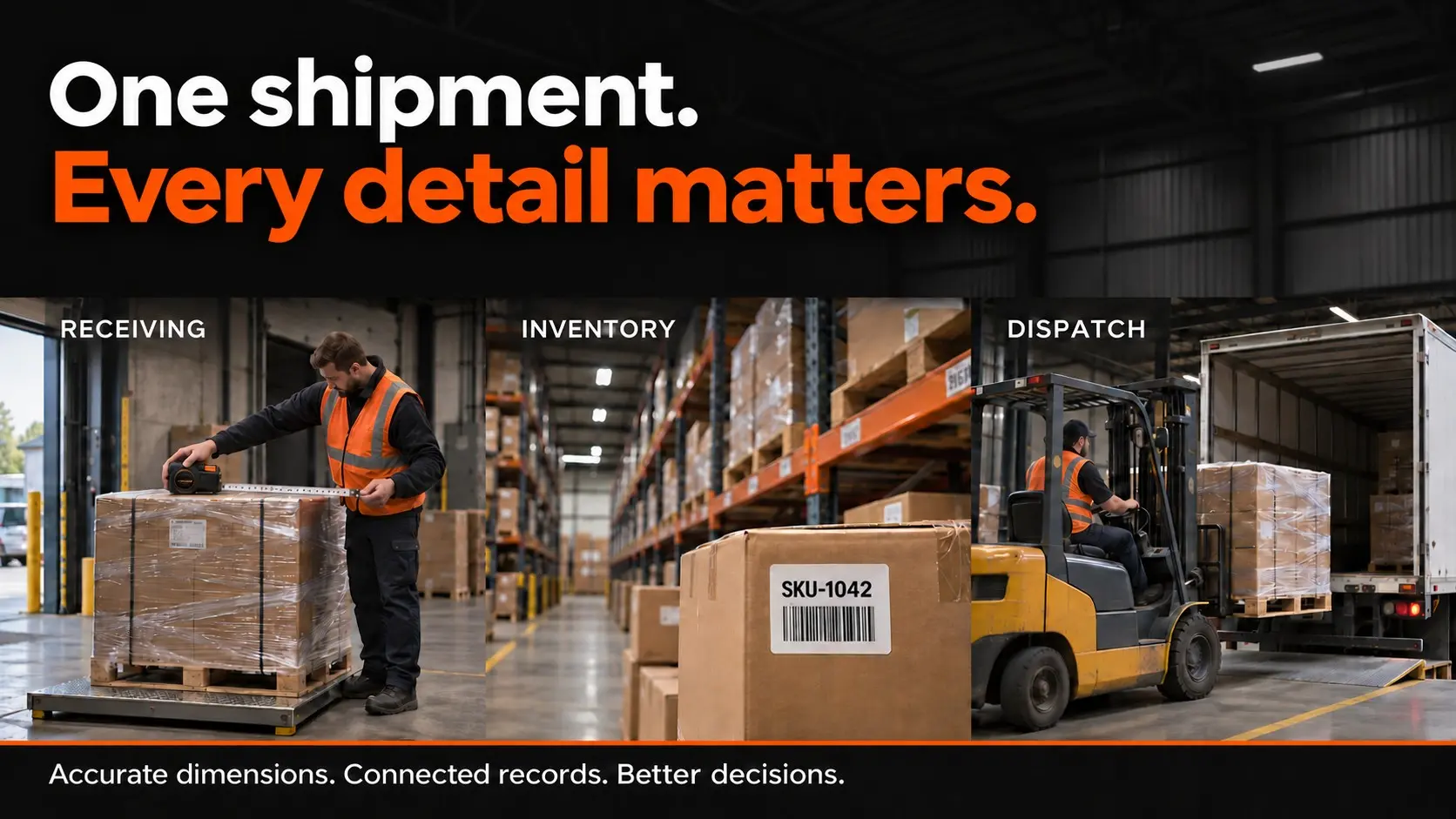
One person measures it. Another rekeys it. A third checks it. Why?
Your warehouse team should be moving freight. Yet missing dimensions, conflicting records and manual entry keep sending them back to work that should already be complete.
Find the pallet. Measure it again. Confirm the weight. Update the record.
Then explain why the figures don’t match.
Freight dimensioning is the process of capturing a shipment’s length, width and height. When those measurements are connected to the correct item or shipment reference, weight and supporting evidence, they give teams a more reliable basis for planning, handling and billing.
Getting that information right matters at three points: receiving, inventory record maintenance and dispatch.
Each is an opportunity to strengthen the record OR pass another problem to the next team – wasting time and money.
Why do inaccurate freight dimensions create so much extra work?
An incorrect measurement rarely stays with the person who recorded it.
It can affect how much space a planner allocates, how warehouse staff stage a pallet and what information billing uses to investigate a charge.
The same problem can create work across several departments:
| Team | What unreliable details can mean |
| Warehouse | Locating freight and measuring it again |
| Planning | Checking figures and revising space allocations |
| Customer service | Chasing confirmation before answering a query |
| Billing | Reconciling conflicting records and investigating adjustments |
Each correction may look small. Across daily shipment volumes, those interruptions take time away from the work your team was hired to do.
Recording dimensions is only the starting point. The more useful question is:
Were the right measurements captured, against the right reference, in a record the next person can use?
Why capture dimensions and weight at receiving?
Receiving is your first physical opportunity to check arriving freight against the information already in your system.
The pallet is there. Your team can identify it, measure it, weigh it and record any relevant differences before it moves further into the operation.
A receiving record should connect:
- The correct shipment or item reference.
- Length, width and height, with the unit of measure.
- Actual weight from suitable weighing equipment.
- Relevant photographs or exception notes.
Where certified measurements are required, the equipment and its use must meet the applicable requirements.
Leaving gaps at receiving means someone else may have to resolve them after the freight has been stored, moved or allocated. What could have been captured at arrival becomes another search, another check and another interruption.
Get it right at receiving, and the next team starts with usable information.
Mobile freight dimensioning with Cubetape brings measurement to the freight, including pallets and awkward items that are impractical to move to a fixed station.
How do consistent dimensions support inventory and master data?
Capturing information at receiving is only part of the job. Keeping it linked to the correct item and consistent wherever it is used is what makes it useful beyond the dock.
One SKU. Three sets of dimensions. Which version does your team trust?
A spreadsheet says one thing. A warehouse note says another. The system holds a third version.
Before comparing those measurements, check that they describe the same thing.
An individual item, a packed carton and a loaded pallet can all have different dimensions. A useful inventory record therefore needs more than three numbers.
It needs a clear connection between:
- Identity: the correct SKU or item code.
- Packaging level: individual item, carton, case or pallet.
- Measurement units: clearly recorded millimetres, centimetres or inches.
- Status: which measurements have been checked and approved for use.
For example, “SKU-1042: 1,200 × 800 × 950 mm” is incomplete if nobody knows whether those dimensions describe a product, a carton or a palletised load.
Consistent capture gives your master data process a stronger source. A clear review and approval process then determines which measurements become the authoritative item record.
Sending measurements to a CargoWise shipment record and updating an item master are separate processes. Your workflow should define which record receives the information and who owns any master data update.
The aim is to give teams a clear, consistent record they can use without repeatedly checking which version is right.
What should you capture before freight leaves?
Consistent item data supports day-to-day operations. At dispatch, the focus shifts to the final shipment.
Receiving measurements describe what arrived. Outbound measurements need to describe what is leaving.
Those may differ if freight has been repacked, consolidated, rebuilt or placed on a different pallet.
Before dispatch, verify the final shipment’s outer dimensions and gross weight. Include the pallet base, packaging and any overhang when determining its overall size.
Connect those details to the shipment reference and available supporting evidence.
| Final dispatch detail | Why it matters |
| Length, width and height | Supports space allocation and shipment rating |
| Gross weight | Supports loading and billing checks |
| Shipment reference | Links the measurements to the correct movement |
| Photographs | Shows the freight’s visible condition and configuration |
| Capture information | Helps teams trace when, where and by whom details were recorded |
When a charge is questioned, your team needs to establish what left the warehouse and what information supported it.
Without a connected record, that can mean searching messages, finding photographs and asking colleagues what they remember. All while the freight is no longer available to check.
A complete record gives your team a stronger starting point for investigating discrepancies and responding to invoice queries.
Capture the evidence while the freight is still in front of you.
How does Cubemetrix connect freight measurements to CargoWise?
Across receiving, inventory capture and dispatch, the same principle applies: identify the correct reference, capture the details and keep them connected.
With Cubemetrix, the workflow brings together Cubetape, CubeX and CargoWise.
1. Identify
Scan the item or shipment barcode with Cubetape to establish the correct reference.
2. Capture
Measure with Cubetape and bring dimensions, weight and supporting shipment information together in CubeX.
3. Connect
Send the captured details into your agreed CargoWise shipment fields through the Cubemetrix CargoWise integration, reducing manual re-entry.
The supported workflow can include dimensions, weight, barcodes and photographs. During implementation, agree how references are matched, where information is sent and how exceptions are handled.
The operational benefit is straightforward: less copying between devices, notes and system records, with captured details connected to the shipment they describe.
What does reliable freight data mean for your bottom line?
Reliable measurement can affect revenue as well as warehouse workload.
In a customer testimonial published by Cubemetrix, an operation reports revenue recovery of US$500,000 per week across 90 sites, following the capture of large and awkward freight dimensions into its system.
That is a customer-specific result. Your opportunity will depend on your freight profile, shipment volumes and current process.
For some operations, the biggest gain may be reducing manual entry and repeated checks. For others, it may be identifying discrepancies earlier or having stronger records to investigate billing adjustments.
The starting point is understanding where unreliable information currently costs your team time or money.
Where should you start improving your freight-data workflow?
Follow one shipment from receiving through to dispatch.
Ask:
- Where are dimensions and weight first recorded?
- How many times is the same information entered?
- Can everyone identify the correct reference and packaging level?
- What triggers a new measurement?
- Where are photographs and supporting records stored?
- How long does it take to investigate a discrepancy?
Look beyond the time taken to measure the freight. Include the work that follows: rekeying, locating records, confirming figures and answering queries.
Measure those activities before changing the process, then compare them after implementation.
That gives you a practical assessment based on your own operation.
Get the details right before the next team needs them
Missing or unreliable information creates another task for someone further down the chain.
Capture it against the correct reference at receiving. Keep item measurements consistent. Verify the final shipment before dispatch.
Connect those details to the records your teams use, so they can spend less time questioning the information and more time doing their jobs.
Less rekeying. Fewer repeated checks. More time to move freight.
Let’s review your receiving-to-dispatch workflow.
Frequently asked questions
What is freight dimensioning?
Freight dimensioning captures a shipment’s length, width and height. These measurements support activities such as space planning, handling and freight rating. Weight is captured separately and linked to the same shipment record.
Should pallet dimensions include the pallet and overhang?
For an overall palletised shipment measurement, include the pallet base and the load’s furthest outer points, including packaging or overhang. Apply the measurement rules required by the relevant service or carrier.
Do you need to measure freight again before dispatch?
If its packaging, configuration or contents have changed, the receiving measurements may no longer describe the outbound shipment. Your dispatch process should verify that the recorded dimensions and weight represent what is actually leaving.
Are SKU dimensions the same as shipment dimensions?
They can describe different things. SKU dimensions may relate to a defined item or packaging level. Shipment dimensions describe freight prepared for a particular movement, potentially including multiple items and a pallet.
Can Cubemetrix send freight data to CargoWise?
Cubemetrix provides a CargoWise connector for supported shipment information. Field mapping and record matching are agreed during implementation so captured information reaches the intended shipment record.
Does better measurement eliminate invoice disputes?
Accurate measurements do not guarantee that every charge will be accepted. Traceable measurements and supporting evidence give teams a stronger basis for reviewing discrepancies and responding to queries.